
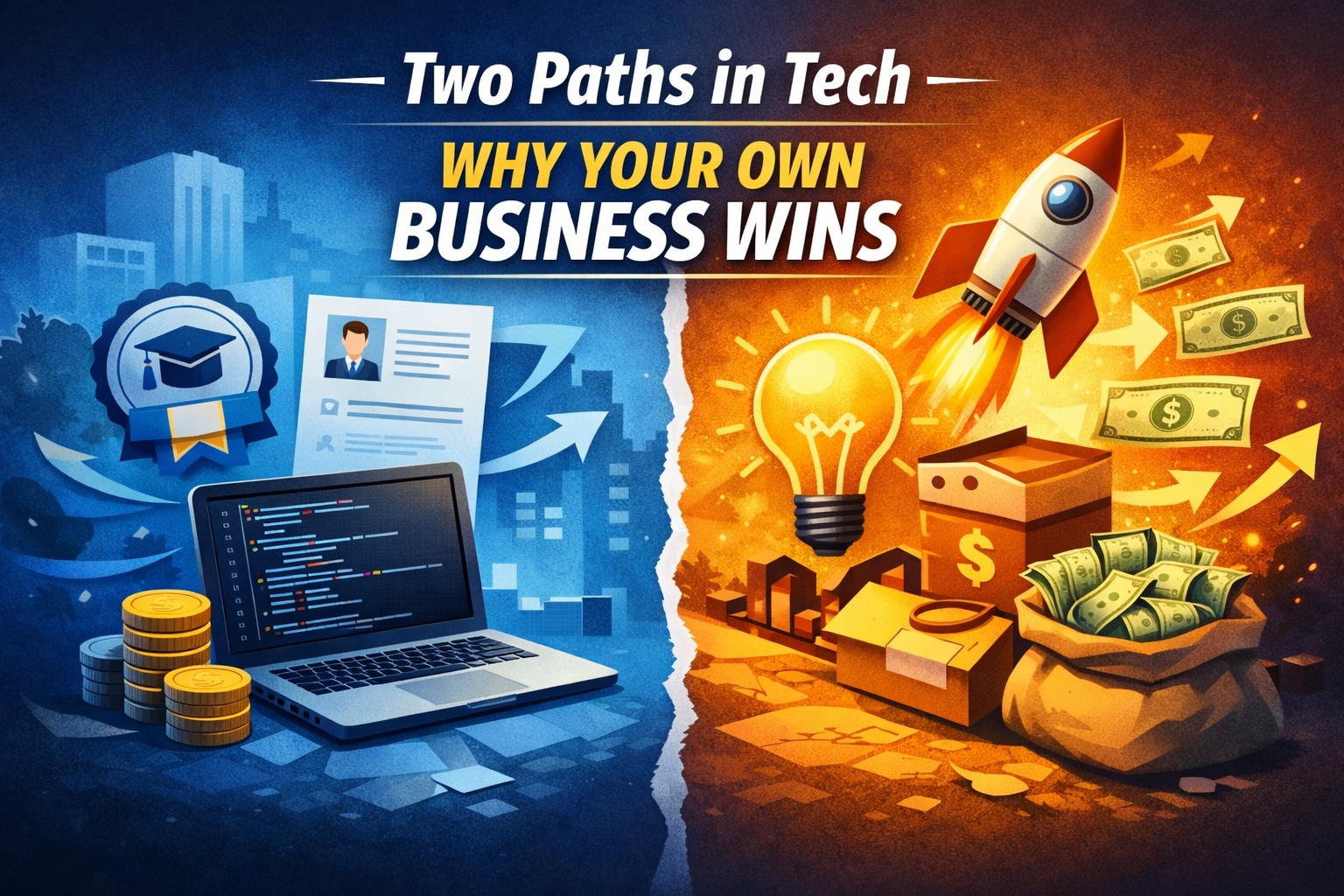

There's a simple truth about making money in the tech world: you need proof that you can deliver value. That proof comes in two forms — certificates or expertise. But there's a third path that most people overlook, and it might be the most powerful of all.
The Certificate Path
Certificates are the traditional route. A degree in computer science, a Google certification, an AWS credential — these are signals that tell employers you've met a certain standard. They open doors, especially for your first job. If you're trying to break into a corporate environment or land a position at a large company, certificates matter. HR departments use them as filters. Recruiters search for them on LinkedIn.
But here's what nobody tells you: certificates get you interviews, not income. They're a starting point, not a destination. Thousands of people hold the same certifications you do, which means you're competing in a crowded pool where salary is often capped by job titles and company budgets.
The Expertise Path
Then there's expertise — real, demonstrable skill. This is what you can actually do, not what a piece of paper says you can do. Expertise shows up in your portfolio, your GitHub contributions, the apps you've built, the problems you've solved. Some of the highest-paid people in tech never finished college. They learned by doing, built things that worked, and let their results speak for themselves.
Expertise takes longer to develop than earning a certificate, but it compounds over time. A certificate becomes outdated. Expertise grows.
The challenge with the expertise path is that it requires you to prove yourself constantly. Without credentials, you need a track record. You need clients who can vouch for you, projects that demonstrate your abilities, or content that showcases your thinking. It's harder to get started, but the ceiling is much higher.
The Truth Most People Miss
Here's what most aspiring tech professionals get wrong: they think these two paths lead to the same destination — a job. They spend years collecting certificates or building skills, all so they can convince someone else to hire them.
But the real leverage in tech isn't working for someone else. It's building something of your own.
Think about it. When you work a job, you trade time for money. You might earn a good salary, but your income is capped by what your employer decides to pay you. You're building someone else's dream, growing someone else's company, making someone else wealthy.
When you build your own tech business, everything changes. Your income is tied to the value you create, not the hours you clock. A single product, app, or service can generate revenue while you sleep. You stop being a cost on someone's spreadsheet and start being the one who writes the spreadsheet.
Why Starting a Tech Business Is More Accessible Than Ever
Twenty years ago, starting a tech company required significant capital, office space, and a team of employees. Today, you can launch a business from your laptop with nearly zero upfront cost.
You can build a SaaS product using no-code tools. You can offer freelance services on global platforms that connect you with clients worldwide. You can create digital products — courses, templates, ebooks — and sell them to thousands of people without ever meeting them. You can start an agency, a consultancy, or a content business that monetizes your knowledge.
The barriers are gone. The only thing standing between you and your own tech business is the decision to start.
You Already Have Enough
If you're reading this, you probably already have skills that others would pay for. Maybe you know how to build websites. Maybe you understand data analysis, automation, video editing, or digital marketing. Maybe you've figured out something that took you months to learn, and you could teach it to others in a fraction of the time.
That knowledge has value. The question is whether you'll keep selling it by the hour to an employer, or whether you'll package it into something that works for you.
Start Before You Feel Ready
The biggest mistake people make is waiting. Waiting until they have one more certificate. Waiting until they feel like an expert. Waiting until the timing is perfect.
The timing will never be perfect. You will never feel fully ready. The people who succeed in tech are not the ones with the most credentials or even the most skills — they're the ones who started before they felt qualified and figured it out along the way.
Your first business doesn't need to be your forever business. Your first product doesn't need to be perfect. You just need to begin.
So here's my challenge to you: stop preparing and start building. Take whatever skill you have right now — certified or self-taught — and find one person who will pay you for it. Then find another. Then package what you've learned and sell it at scale.
The certificate path and the expertise path both have value. But the real money, the real freedom, and the real fulfillment come from owning something yourself.
The tech industry has created more millionaires than any other field in history. Almost none of them got rich from a salary. They built something.
It's your turn.



0 Comments