
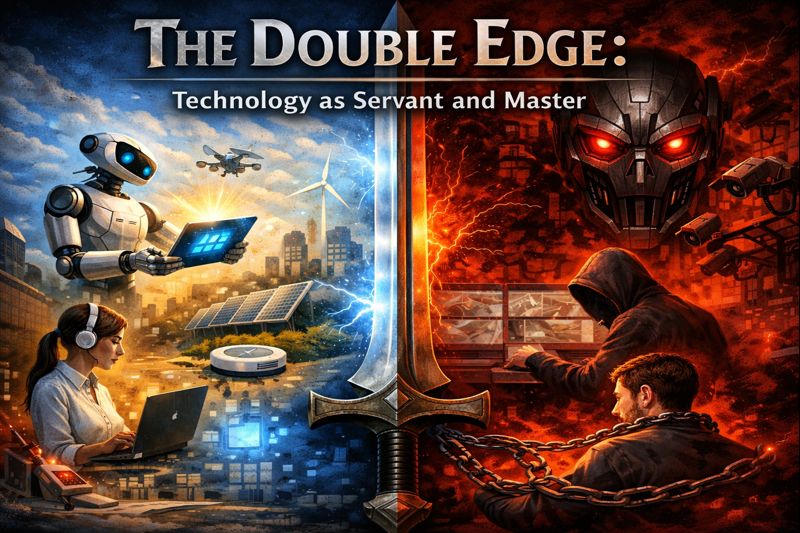

The Paradox of Progress
We live in an age of unprecedented convenience. A device in your pocket connects you to the sum of human knowledge, allows you to speak face-to-face with someone on the other side of the planet, and can summon food, transportation, or entertainment with a few taps. Technology has extended human capability in ways that would have seemed miraculous to previous generations. And yet, many of us feel more scattered, more anxious, and further from our deepest purposes than ever before. This paradox sits at the heart of modern life.
The Genuine Gifts of Technology
The benefits of technology are not difficult to enumerate. Medical advances have doubled life expectancy in the span of a century. Communication tools have collapsed distance, allowing families separated by oceans to remain close, enabling movements for justice to organize across borders, and giving voice to those who would otherwise go unheard. Automation has freed us from countless hours of drudgery—we no longer spend our days washing clothes by hand or walking miles to deliver a message. Knowledge that once required years of study or access to elite institutions is now freely available to anyone with an internet connection. For the disabled, the isolated, and the curious, technology has been genuinely liberating.
But liberation is not the only story technology tells. There is another narrative, quieter and more insidious, about how the tools meant to serve us gradually become our masters.
When Tools Become Masters
Consider the smartphone. It was designed to make communication easier, to put information at our fingertips, to help us navigate the world. But somewhere along the way, the relationship inverted. We now check our phones compulsively, sometimes hundreds of times a day. We reach for them in moments of boredom, in moments of discomfort, in moments that once might have been filled with reflection or genuine connection. The device that promised to connect us to the world often disconnects us from the people sitting across from us, from the texture of our immediate experience, from the silence in which deeper thoughts take shape.
This is not an accident. Many of our technologies are deliberately engineered to capture and hold attention. The infinite scroll, the autoplay feature, the notification ping—these are not neutral design choices. They are the products of vast research into human psychology, designed to exploit our vulnerabilities: our craving for novelty, our fear of missing out, our hunger for social validation. We are not simply using these tools; we are being used by them, our attention harvested and sold. The economy of the digital age runs on a currency extracted from our focus, our time, and increasingly, our sense of self.
The Fragmentation of Attention
The consequences extend beyond wasted hours. When our attention is perpetually fragmented, we lose the capacity for deep work—the sustained concentration required for creativity, mastery, and meaningful contribution. We become reactive rather than intentional, responding to whatever stimulus arrives rather than pursuing what matters most. The urgent crowds out the important. We can answer a thousand emails and still feel we have accomplished nothing of significance.
The Performance of Self
There is also the question of identity. Social media invites us to curate versions of ourselves for public consumption, to measure our worth in likes and follows, to compare our unedited lives against the highlight reels of others. This performance of selfhood can become exhausting and alienating. We may begin to lose touch with who we are when no one is watching, what we want when no algorithm is suggesting, what we think when no feed is shaping our perception.
The Erosion of Purpose
Perhaps most troubling is technology's effect on our sense of purpose. Purpose requires sustained attention to questions that do not yield easy answers: What kind of life do I want to live? What contribution do I want to make? What relationships do I want to nurture? These questions demand patience, solitude, and the willingness to sit with uncertainty. But technology offers an endless supply of distractions, an escape hatch from difficulty. Why wrestle with hard questions when you can scroll, swipe, binge, or click? The path of least resistance leads us away from depth and toward surfaces, away from purpose and toward mere stimulation.
The Illusion of Freedom
Freedom, too, becomes complicated. Technology promises freedom—freedom from inconvenience, from boredom, from the limitations of our bodies and geography. But freedom is not simply the absence of constraint; it is the presence of genuine choice. And genuine choice requires awareness, intention, and the capacity to act on our values rather than our impulses. When technology hijacks our attention and manipulates our desires, it undermines the very conditions that make freedom meaningful. We may have more options than ever before while feeling less free, because we have lost the inner clarity to choose wisely.
Reclaiming Intention
What, then, is to be done? The answer is not to reject technology wholesale—that path is neither possible nor desirable for most of us. The benefits are real, and the genie will not return to the bottle. But we can become more intentional about our relationship with our tools. We can recognize that every technology embodies values and incentives, and we can ask whether those values align with our own. We can create boundaries—times and spaces where devices are set aside, where our attention is protected, where silence and presence are allowed to do their work. We can seek out technologies designed to serve human flourishing rather than exploit human weakness.
The Choice Before Us
Most fundamentally, we can remember that technology is a means, not an end. The good life is not a life optimized for efficiency or saturated with information. It is a life of connection, meaning, growth, and contribution. Our tools should serve these deeper aims, not supplant them.
The choice is still ours—for now. The question is whether we will exercise it consciously, or surrender it by default to the path of least resistance. In an age of infinite distraction, the cultivation of attention, intention, and inner freedom may be the most radical act available to us. It is also, perhaps, the most necessary.
0 Comments